
The oldest street of Uzhhorod was once called Zamkova. It was the only street located within the outer defensive structures of the castle. At the beginning of the 19th century the name Kapitulna was gradually established for the street, and in Soviet times it was renamed Kremlivska.
Uzhgorod Castle (Kapitulna St., No. 33) is the main attraction of the city. The castle is located in the center of the city on Castle Hill.
The walls, bastions, palace and foundation of the Gothic castle church of the 14th century have been preserved.
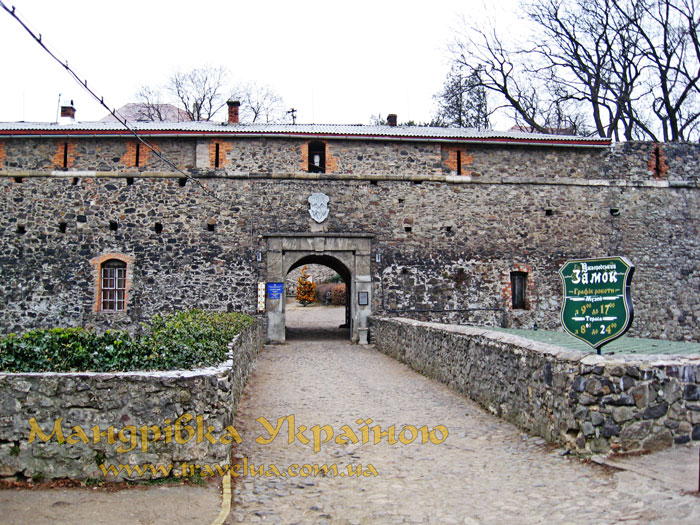


Currently, the castle houses Transcarpathian Museum of Local History.

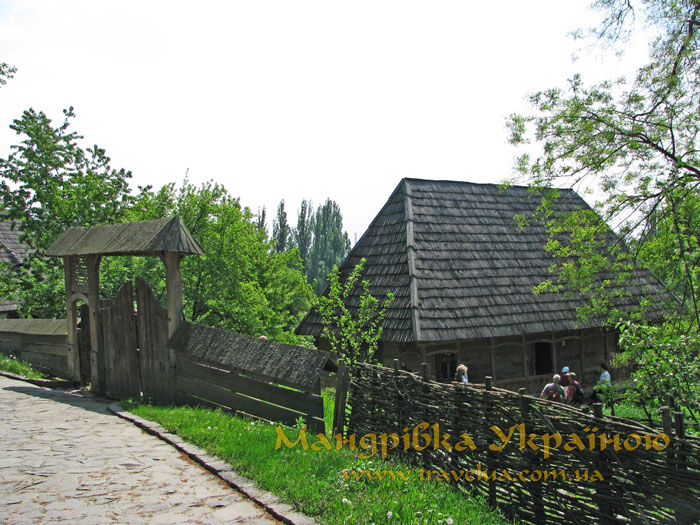
Right next to the walls of the majestic castle is Pydzamkovy Park and one of the first in Ukraine Zakarpattia Museum of Architecture and Life (Kapitulna St., No. 33a), built in 1970 in a place called the “Witch’s Pit”, where those accused of witchcraft used to be burned. Residents of the city call the museum simply “village”.

The exposition includes 29 objects and exhibitions in the main building. Visitors can get acquainted with typical Ukrainian, Hungarian and Romanian architecture.
The wooden church of St. Archangel Michael in 1777, with a tower height of 22 m.

Opposite the museum is one of the oldest educational institutions on the territory of Ukraine – the former building of the Greek-Catholic seminary (1883-1886), where, by the way, the first President of Carpathian Ukraine Augustyn Voloshyn taught (str. Chapter, No. 24). In the interwar period, Preparandia became the center of the Ukrainian national movement of the region. On the wall of the building there are two memorial plaques – to Augustyn Voloshyn and the students of the seminary who died on Krasny Pol near Khust on March 15, 1939.

The ancient educational institution ceased to function as intended in 1947. Today, the premises of the seminary are occupied by the Faculty of Law of Uzhhorod University.
At the end of the 18th century, when the seat of the Mukachevo Greek Catholic diocese was moved to the Kapitulna, the right side of the street was completely given to it, and later the cathedral chapter was located here – the bishop’s advisory body, which consisted of seven canons headed by the dean of the chapter (archpriest). Over time, a peculiar Greek-Catholic quarter with its own special face grew here. Architecturally perfect houses that belonged to the leadership of the diocese, houses in which the canons or the so-called “canonical row lived” attract attention. In its current form, the canonical series was erected in 1908 during the time of Bishop Yuliy Firtsak.

The canonical row is interrupted by the two-story building of the former orphanage (boarding house) for priestly orphans and the poorest students of the Uzhgorod Gymnasium, on the facade of which the Latin inscription Orphanotrophium has been preserved. The institution began its work in the fall of 1841 thanks to the care of Bishop Oleksiy Povchyi, the famous figure Mykhailo Luchkai and the vicar Ivan Churgovych. The dormitory acquired its modern appearance in 1906.
The next building is known for the fact that in the 17th century the famous noble family of Dyendyesha lived here in the 19th century. there was a Greek-Catholic Sunday school, and in the 20s of the 20th century. Augustyn Voloshyn lived in the house for some time. On the facade of the building there is a memorial plaque to the famous Transcarpathian artist Yosyp Bokshay, who worked here as a teacher at the Uzhhorod School of Applied Arts in 1945-1956. The school was located in the building from 1945 to 1985.

On the opposite side of Kapitulna Street, another diocesan boarding school for boys “Alumnae” attracts attention, which was located in the modern building №18
Most of the former buildings of the Mukachevo Diocese were transferred to the Uzhgorod University after the termination of the activity of the Greek-Catholic Church in Transcarpathia (1949), in whose ownership they remain to this day.
Walking further along Kapitulna Street, we get to the majestic Cathedral of the Cross and Ascension (Kapitulna St., No. 11), which was founded back in 1640.
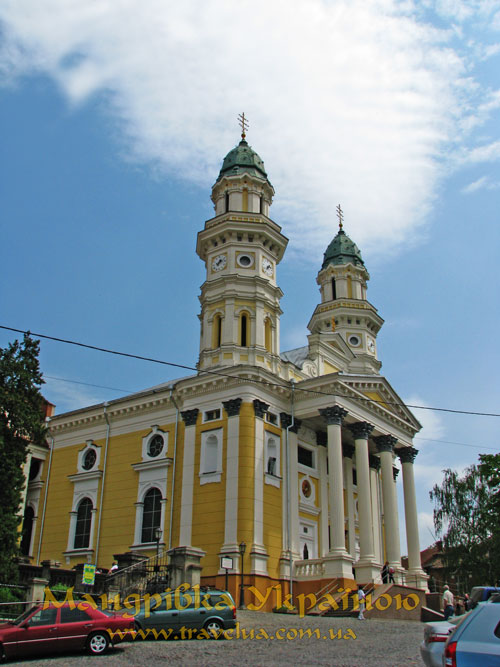


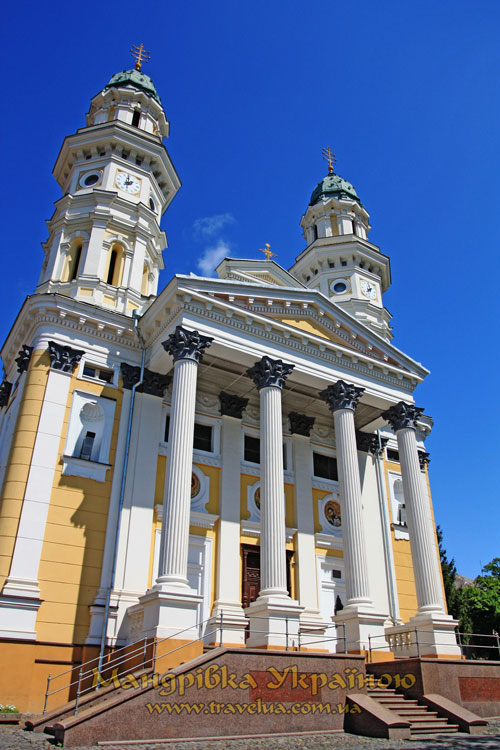

The temple was built for the Jesuits at the expense of Jan Druget. In 1775, the building was given to the Mukachevo Greek Catholic Diocese, which at that time was headed by Bishop Andrii Bachynskyi.

The facade of the church was designed by the Italian architect Luca Fabri in 1877. The cathedral has a four-column portico of the Corinthian order on a high plinth. The central nave is covered with a semicircular vault. The interior of the cathedral is dominated by the Rococo style. On the vaults of the central nave there is a large composition “Recovery of the Holy Cross” by Transcarpathian artist Josyp Bokshay. Paintings from the 18th century have been partially preserved. and paintings by F. Vydra.

In 1949, the church was handed over to the Russian Orthodox Church, and in 1991 it was returned to the Greek Catholics.
Under the cathedral there is a crypt with the burial of bishops.

To the left of the cathedral is the former Jesuit college of 1644 – later the palace of the archbishops, and today the university library (Kapitulna St., No. 9).
The facade of the building is decorated with hollow porticoes and stuccoed coats of arms of Bishop Bachynskyi.

Then, turning to the left, we pass by the late 18th century building, which now houses a commercial technical school (Kapitulna St., No. 1/3). There are data that in this city in the second half of the 17th century. there was a military barracks.

There are no comments for this post. Comment or ask questions first