
Dovge (Hungarian Dolha) is a village in the Irshava district, Transcarpathian region, located in the valley of the Borzhava River.
Long is based on the border between the 13th and 14th centuries. Initially, it was a rest stop for merchants on the trade route, and later, people began to settle here. The first written mention of the village of Hosszumezo, which is the Hungarian translation of the Ukrainian name Dovge Pole or Dovgopole, dates back to 1383. According to legend, the village was named after the first owner – an extremely strong and skillful warrior Dovgai, who defeated the Tatar hero and saved the peasants from captivity. Grateful people gave Dovhai the right to take as much land as he could go around in a day. Parubok bypassed part of the valley of the Borzhava River, where he later settled with his family.
Since 1409, the village was owned by Ambruš Dovgai. In 1417, the barons of Dovgai built a wooden church and a castle-fortress in the village, which was surrounded by an earthen rampart and a moat. In 1514 the castle was destroyed by rebelling peasants who joined the forces of György Doži. For centuries, the villagers dismantled the ruins and built their houses from them.

On June 7, 1703, a battle between Kuruk rebels and Habsburg troops took place near Dovhy. Villagers also joined the rebels. At the mass grave of 50 dead rebels in 1903, at the expense of the residents of Dovgoi and nearby villages, a monument was erected in honor of the 200th anniversary of the memorable battle – a column crowned with a turul.
In 1711, Dovge became the property of Count László Teleki, as thanks for his active participation in the defeat of the rebel forces. The new owner started the reconstruction of the feudal castle, which became the summer residence of the new owner.

Representatives of the European nobility liked to come here for rest and hunting. Local peasants kept expensive horses and built special roads that passed through the middle of the mountain slopes and, walking along them, the rider could clearly see both the top and the foot of the ridges.
In 1712, the construction of the palace began. Researchers believe that the main body of the ensemble was built on the site of an old castle of the 15th century, from which the remains of the walls have been preserved in the basement.


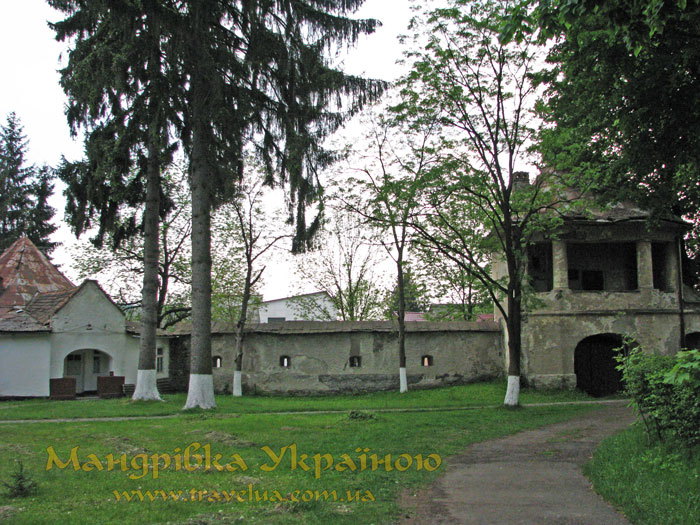
The Palace-fortress complex was created over several decades and was finally completed by 1798. First, residential premises were built, in the middle of the 18th century. the manor was surrounded by strong fortress walls with corner towers forming a square of 65×65 m, and in 1774 the construction of the entrance tower was completed.
The main building is one-story, manor house type, rectangular in plan, covered with a four-sloped roof with a gap. The main facade is decorated with risalite and pilasters, large rectangular windows are framed with moldings.
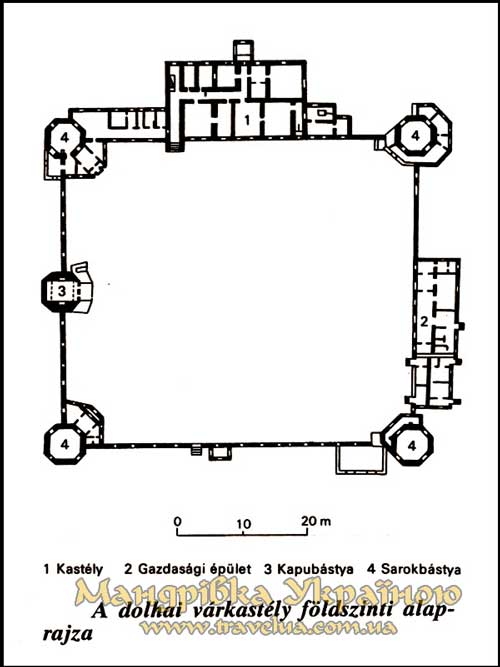
The Dovzhan Palace-Fortress is the only example of rural manor architecture of the Middle Ages in Europe, but, unfortunately, the complex is now in a deplorable state, and a tuberculosis hospital has been operating on its territory since 1954.



In the 18th century the rapid development of the village began: lime was burned in Dovgomy, roofing material was produced for sale, a paper factory and a weaving workshop began to operate, where hemp and flax, which were grown on the lands of Count Teleki, were processed. In 1850, the “Gamora” ironworks began operating in Dovhom, and in 1854, a blast furnace with a height of 28 m was put into operation. The plant’s products were even exported to Serbia, Romania, and Hungary.

In other gender 19th century the town had a coat of arms: on a red background – a castle with a gate and three towers topped with weather vanes. The castle on the coat of arms is a symbol of the ancient fortress, the red background is a memory of the battles of past centuries, and the green color symbolizes the fertile valley of the Borzhava River.

In 1871, a church primary school was opened in the village. One teacher taught literacy in Ukrainian mainly to children of wealthy parents. Since 1907, teaching at the school was conducted in the Hungarian language.

There was only one doctor in the entire Dovzhansk district who provided paid medical care, so many residents died from infectious diseases.
At the beginning 20th century a large part of the villagers emigrated to the USA, Canada and European countries in search of a better life.
In March 1919, Soviet power was proclaimed in Dovhom, but already at the end of April, the village was occupied by Romanian troops. In the summer of 1920, Czechoslovak troops were quartered in Dovhoy, and in March 1939, Hungarian troops entered the village, and in October 1944 they were replaced by units of the Red Army. Since 1971, Dovge has been part of Irshava District, Zakarpattia Oblast.
Since 1993, the village has been operating the only higher educational institution in Ukraine located in a rural area – Higher Economic college “Bachelor” named after V. Yakub.
In Dovgom there are five active churches of different denominations, four of them stand peacefully side by side on the main street of the village, and the fifth is on the outskirts.

The most modern modern church in the area is the Roman Catholic Church of the Sending of the Holy Spirit (13 Lesya Ukrainka St.). The temple was built in 1994-1999 on the site of the old technically unreliable church building of 1920.
Nearby is the Greek Catholic Church of St. Elijah.
In the early 1990s, the Greek-Catholic community wanted to reclaim the church building, but encountered opposition from the already numerous Orthodox community. The leadership of Dovgo together with church communities began to solve the problem. At first it was about alternate service, but at the last moment the Orthodox decided not to let Greek Catholics into the church. The question arose about the construction of a new Greek-Catholic church. The village council allocated a plot of land for construction, and funds were collected throughout the region with the help of the village authorities, sponsors, foreign missions and foundations. The new church was opened in 2002 and consecrated in 2003.
Assumption Church (MP), 1911 (former Greek Catholic Church)
It is interesting that according to the census of 1939, there were only four families in the village who professed the Orthodoxy of the Moscow Patriarchate. Since the end of the 1940s, the situation has changed radically. The persecution of Greek Catholics, who were considered “bourgeois nationalists”, began. Parishioners were forced to go to the Roman Catholic church or pray in the building of the same church even before, but according to Orthodox canons.
It is believed that there are no inter-confessional quarrels in Dovgomy, but for example, an Orthodox priest is not present at the Greek-Catholic St. Elijah, despite the fact that he is always invited. However, there were cases of joint service.
Slovak Church
In Dovhom, numerous works of children’s writer Mariyka Pidhiryanka saw the light of day for the first time. The outstanding composer Mykhailo Mashkin wrote his best songs here.


Where to stay
When you zoom out of the map, you can see more offers. Place the cursor on the rectangle with the price for
to see information about the accommodation, or click to proceed to the reservation.
Booking.com
There are no comments for this post. Comment or ask questions first