
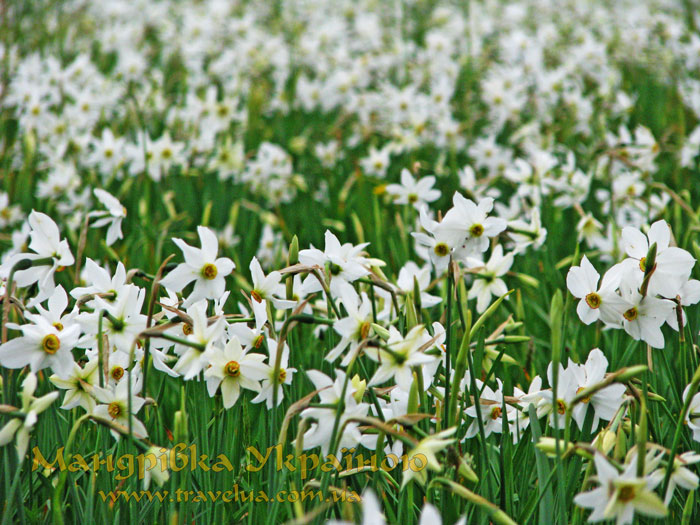
A unique wildlife attraction – “Daffodil Valley” is located on the outskirts of Khusta in the Kireshi tract between the Tysa and Khustets rivers. According to legend, it was in the mirror waters of Khustets that the son of the river deity Kefissa and the nymph Liriope – Narcissus saw his reflection, fell in love and died of longing. And on the bank of the river appeared a delicate flower with a cold beauty and an intoxicating aroma.

Narrow-leaved narcissus population
The population of narrow-leaved narcissus (Narcissus angustifolius subsp. radiiflorus), which grows here, is unique in that it is not in the mountains, but on a plain 180-200 m above sea level. m. Similar natural objects have been preserved in the Alps, mountainous regions of Romania and some Balkan countries, but they are smaller in area and at an altitude of more than 1000 m above sea level. r. m.
Protection of the valley began during the times of Austria-Hungary. The government of Czechoslovakia also paid attention to the protection of the protected area. But the Soviet authorities did not hesitate to carry out reclamation works on 50 hectares of the valley and gave the plowed land for agricultural land, and only thanks to the petitions of Professor V. Komendar, a large part of the territory was transferred to the protection of the Carpathian Biosphere Reserve. The area of the reserve is 257 hectares, more than 500 species of plants grow here, 15 of which are listed in the Red Book. The total area of daffodil fields reaches about 170 hectares.


Flowering in “Daffodil Valley” usually begins in the first half of May and lasts about two weeks. During this period, thousands of tourists come here not only from Ukraine, but also from abroad. Security guards ensure that visitors do not trample or pluck daffodils, and defiant violators face a fine of about $15 for one plucked flower. But, unfortunately, even such measures do not save the flowers from destruction and the “Valley” is gradually decreasing. The unfavorable human factor is also accompanied by natural ones – changes in humidity and climate.
Many tales and legends are associated with “Daffodil Valley“. According to one of them, the owner of the Khust Castle had a daughter, Rusya, whom the potter Ivanko secretly loved. On the occasion of his daughter’s coming of age, the prince arranged a lavish reception, where the wealthiest grooms of the district gathered. The poor potter also came to congratulate the girl, and as a gift he prepared an extremely beautiful vase, painted on the outside with white daffodils. The girl reciprocated the young man and the young people began to meet secretly in the valley, not far from the city. When the girl’s father found out about this relationship, in a fit of rage he grabbed a beautiful vase and threw it from the fortress wall. In the morning, the entire valley was covered with a white carpet of graceful daffodils.

The appearance of the Valley of Narcissus is also associated with the history of the Nankiv miracle-working icon of the Holy Mother of God. According to legend, at the end of the 17th century. an image of the Virgin Mary appeared in the village of Nankovo. The local community appealed to the owner of the field where the miracle took place with a request to build a temple or chapel at the place where the image appeared, but the landowner refused. Believers tried to take the icon away with a cart pulled by oxen, but the animals did not budge. The irritated landowner began to drive the oxen with whips and accidentally hit the icon. A scar appeared on the face of the Mother of God, and tears flowed from her eyes. The family of the landowner was punished for such a great sin, and the icon was taken out along the Khustets river valley. Since that time, daffodils began to grow along the path along which the icon was transported.
Another legend tells how the Turkish army captured Khust Castle, and the clever inhabitants of the city, as a sign of humility and respect for the winners, brought pillows stuffed with daffodils as a gift. Enemy soldiers did not know that daffodils are poisonous flowers, and after falling asleep on such pillows, a person may never wake up again.


“Valley of Narcissus” Khust branch of the Carpathian Biosphere Reserve
Working hours: from May 1 to May 25 from 9:00 a.m. to 9:00 p.m.
Entrance fee: Adults – 25 hryvnias, students – 20 hryvnias, schoolchildren – 10 hryvnias, after flowering the ticket price may be lower.
There are no comments for this post. Comment or ask questions first