
Brief History
Bamberg was founded over a thousand years ago and quickly became a spiritual center of the region. In 1007, Emperor Henry II established a bishopric here and later built the Cathedral, which remains the city’s main landmark today. Thanks to the fact that Bamberg avoided large-scale destruction during wars, it has been included in the UNESCO World Heritage List.
Where to Stay
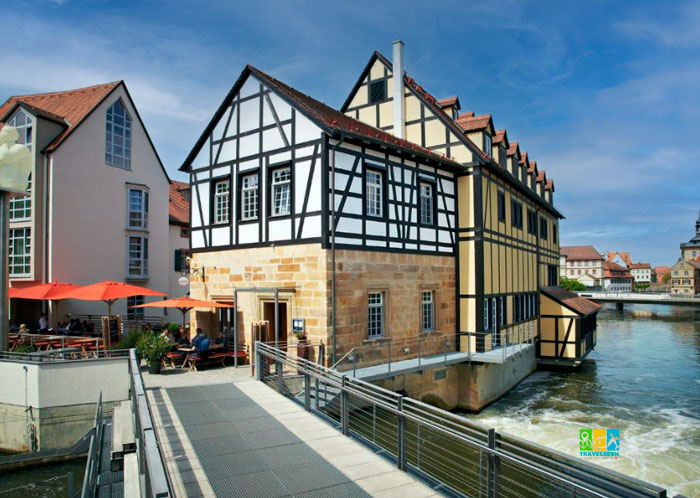
Hotel Nepomuk — a charming boutique hotel (pictured) located right above the water, in the very heart of Bamberg’s Old Town. The rooms offer views of the canals and the picturesque façades of historic buildings. An ideal choice for a romantic getaway or a peaceful stay in the medieval atmosphere of the city. Nearby is Eckerts Wirtshaus, a modern Franconian restaurant with river views — a perfect place for lunch or dinner. Tip: try the local classics — sausages with sauerkraut or the famous Franconian beer Schlenkerla Rauchbier.
Ibis Styles Bamberg — a modern hotel in the city center featuring bright design, comfortable rooms, and a buffet breakfast. A great option for those looking for comfort and good value for money close to the main sights.
Altstadt Apartment — cozy apartments in a historic building overlooking the canals and narrow streets of the Old Town. Perfect for independent travelers or couples who want to feel like locals and enjoy the atmosphere of Bamberg at their own pace.
What to see
Bamberg Old Town (Altstadt von Bamberg)
The heart of the city and a UNESCO World Heritage Site. Its streets have preserved the medieval layout, half-timbered houses, and the atmosphere of old Bavaria. Take a leisurely walk through the narrow alleys, stop by cafés, antique shops, and wine cellars, climb up to the cathedral, or simply enjoy the views of the river. This is the place to truly feel the spirit of Bamberg.

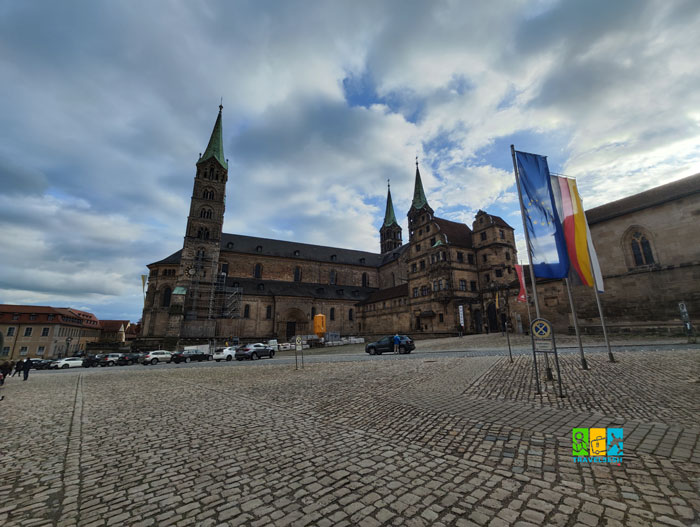
Bamberg Cathedral (Bamberger Dom)
The city’s main shrine and one of the most magnificent Romanesque-Gothic buildings in Germany. Inside, you’ll find the tombs of Emperor Henry II and his wife Cunigunde, as well as the famous sculpture of the Bamberg Horseman — a mysterious figure that has become a symbol of the city. The cathedral impresses not only with its architecture but also with its panoramic views of the old town from its terraces.

Crypt of Bamberg Cathedral (Krypta im Bamberger Dom)
One of the oldest parts of the cathedral, preserved since the 11th century. Here rest Emperor Henry II and his wife Cunigunde — the only royal couple canonized by the Catholic Church. The atmosphere of the crypt is filled with peace and grandeur — a place of quiet reverence and historical depth. The stone vaults, ancient tombs, and soft lighting create a sense of meeting the Middle Ages face to face.

Old Town Hall (Altes Rathaus)
One of Bamberg’s most striking landmarks, built right in the middle of the Regnitz River on an artificial island. Its facades are decorated with colorful frescoes that create the illusion of three-dimensional figures. According to legend, the townspeople built the town hall on water because the bishop refused to give them land. The bridges offer wonderful views — one of the most photogenic spots in Bamberg.

New Palace (Neue Residenz)
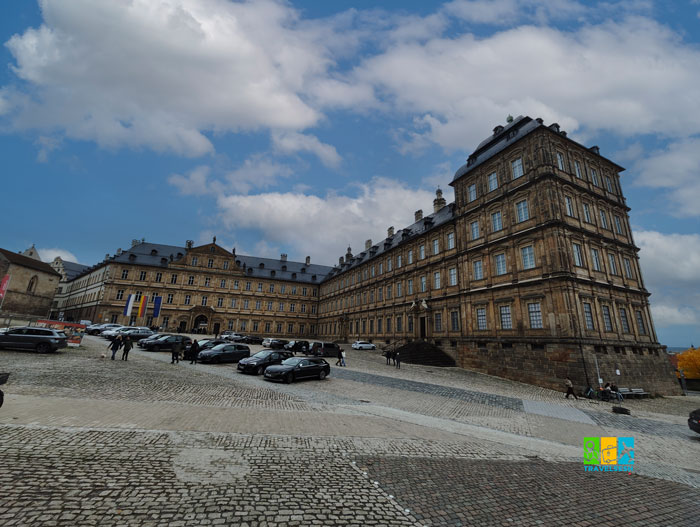
An elegant residence of the Bamberg prince-bishops, remarkable for its Baroque and Renaissance interiors. Inside, you can see sumptuous halls with frescoes, antique furniture, and art collections, while the terraces offer panoramic views over the Old Town.

Behind the palace lies the Rose Garden (Rosengarten), with over 400 varieties of roses — a perfect place to relax while enjoying a view of Bamberg.

State Library of Bamberg (Staatsbibliothek Bamberg)
One of the oldest libraries in Germany, founded in the 17th century. It holds over half a million volumes, including medieval manuscripts, incunabula, and unique maps. The highlight of the collection is the Bamberg Apocalypse — an illuminated 11th-century manuscript listed in UNESCO’s Memory of the World Register. For visitors, the library is fascinating as a cultural center with exhibitions and a chance to admire ancient books in authentic historic halls.
Old Court (Alte Hofhaltung)
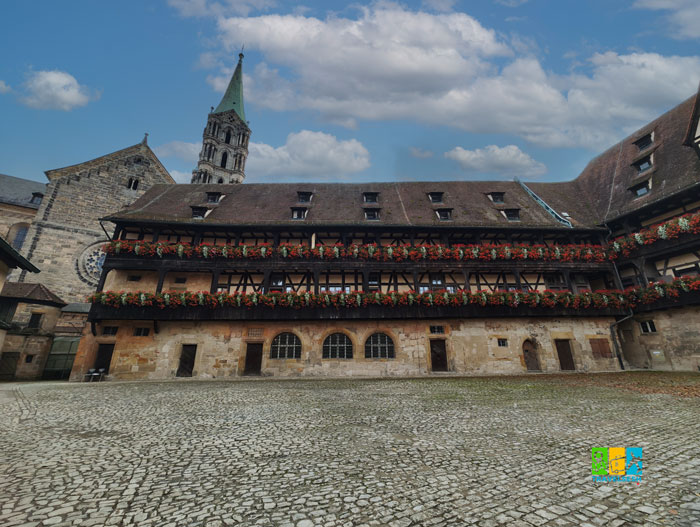
A historic complex of buildings on Domplatz Square that once served as the residence of Bamberg’s bishops. Its picturesque half-timbered facades and inner courtyard capture the true spirit of a medieval city. Today, the courtyard often hosts historical fairs, festivals, and open-air theater performances. From here, there’s a beautiful view of Bamberg Cathedral — one of the city’s most impressive landmarks.
Christ Church (ehem. Marienkapelle)
A small but historically significant church located near Domplatz Square. Built in the 13th century as the Chapel of St. Mary, it was once part of the episcopal complex and used for private services. After secularization, the chapel gained new life as the Christ Church (Christuskirche). Today, it is a quiet place for reflection and prayer, known for its old frescoes, Gothic vaults, and peaceful atmosphere amidst the lively tourist center.
Little Venice (Klein Venedig)
One of the most romantic corners of Bamberg. This charming row of former fishermen’s houses with wooden facades and flower-decked windows stretches along the Regnitz River. In the warmer months, you can take a boat ride or snap photos of the lovely canals that earned this district its nickname “Little Venice.”
Brudermühle Mill and Weir (Staustufe Brudermühle)
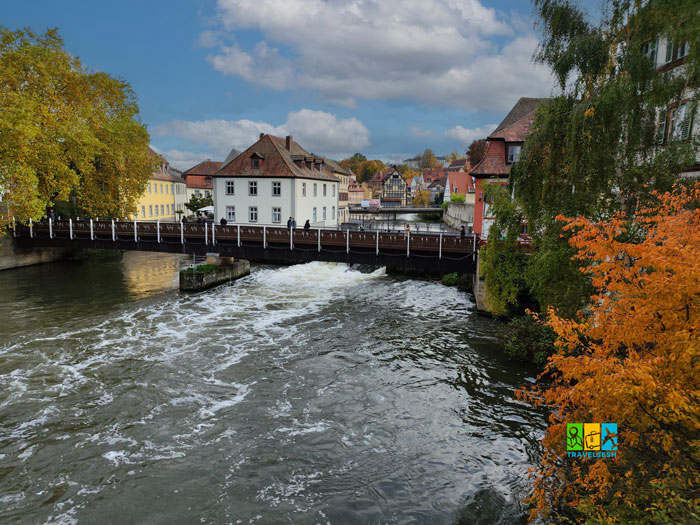
One of Bamberg’s most picturesque spots, located near “Little Venice.” Here, the Regnitz River splits into several branches, forming a beautiful waterfall and an old weir that once powered the city’s mills. The former mill building — Brudermühle — has now been converted into a cozy hotel with a restaurant where you can enjoy views of the water and the old town. It’s an ideal place for walks and photos, especially in the evening when the lights reflect in the water and highlight the magical atmosphere of historic Bamberg.
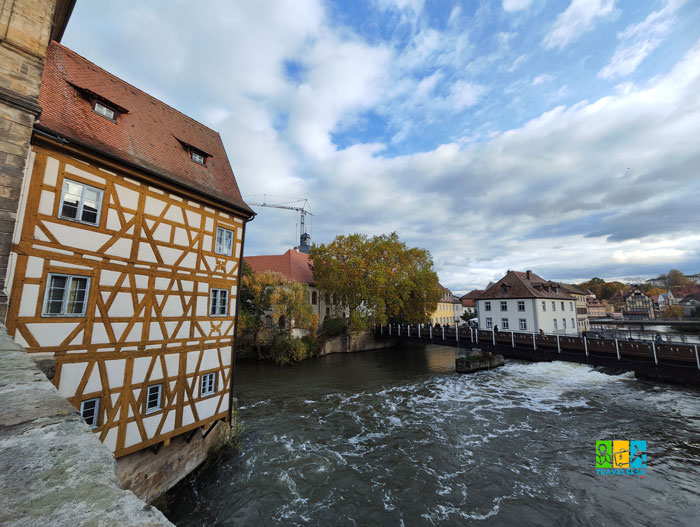
Geyerswörth Bridge (Geyerswörthsteg)
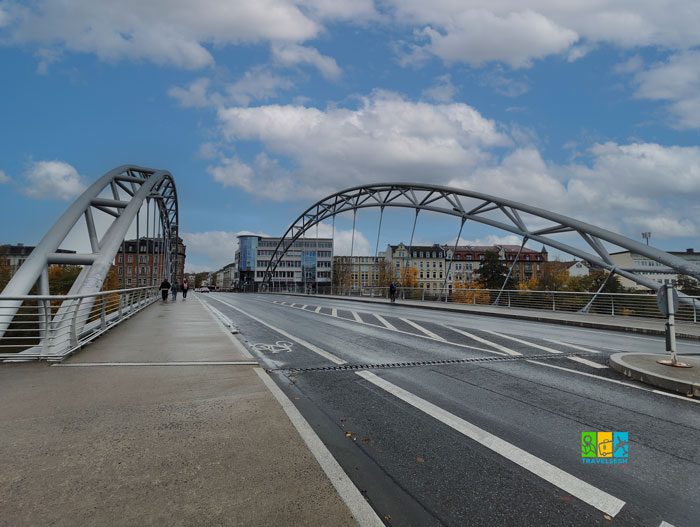
A cozy pedestrian bridge in the very heart of Bamberg that connects Geyerswörth Island with the Old Town. From here, you can enjoy one of the best views of the Old Town Hall, which seems to rise right out of the water. It’s a favorite spot for photographers and visitors—especially at sunset, when the buildings reflect in the calm waters of the Regnitz. Geyerswörth Bridge is an ideal place for a romantic walk.
Geyerswörth Residence Palace (Residenzschloss Geyerswörth)
An elegant Renaissance building on a small island between the branches of the Regnitz River. Once the residence of the Prince-Bishops of Bamberg, it is now one of the architectural gems of the old town. The palace is known for its refined façades, towers, and inner courtyard, and from its grounds, you can admire a beautiful view of the Old Town Hall.
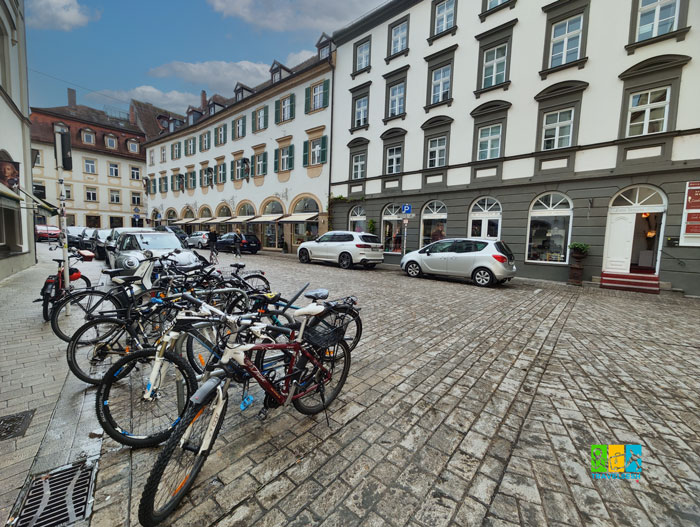
Aula in the Dominican Building of the University of Bamberg (Aula im Dominikanerbau der Universität Bamberg)
One of the most exquisite historic halls of the university, located in the former Dominican monastery from the 13th century. Today, it serves as a venue for ceremonies, lectures, and concerts, where history meets the academic spirit of modernity. The interior is truly impressive—high vaults, frescoes, stucco, and baroque details create an atmosphere of true grandeur. The Aula is not only an academic center but also an architectural landmark of Bamberg, open to visitors during cultural events and guided tours.
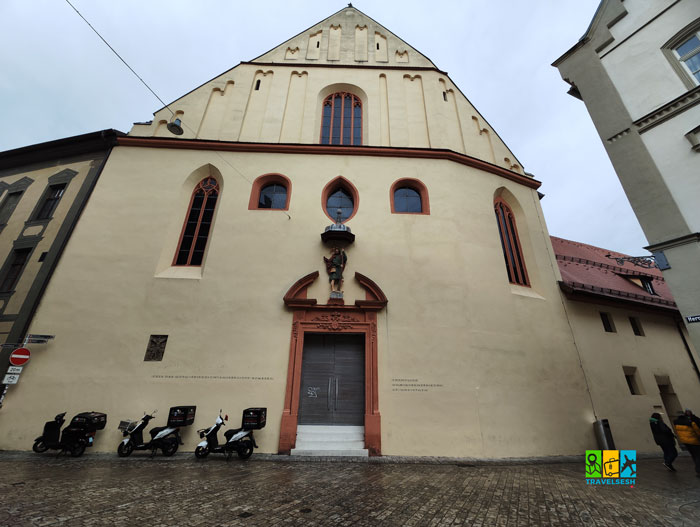
Old Slaughterhouse (Alter Schlachthof)
The former 19th-century city slaughterhouse, now transformed into a modern cultural and gastronomic space. Located by the Regnitz River, it has preserved its historic red-brick architecture, complemented by contemporary design elements. Today, it hosts restaurants, art spaces, and event halls where concerts, exhibitions, and festivals take place. It’s a popular spot among locals and visitors alike—perfect for experiencing the fusion of Bamberg’s history and modern life.
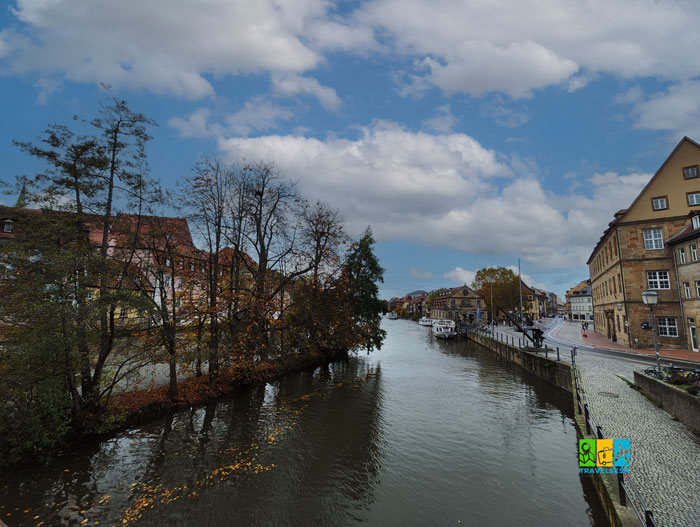
“Centurione” by Igor Mitoraj (Igor Mitoraj “Centurione”)
An impressive bronze sculpture by the Polish artist, located next to Bamberg Cathedral. The work combines ancient aesthetics with modern symbolism—a warrior’s face with cracks that symbolize the fragility of human strength and time. The sculpture fits harmoniously into the historic surroundings of Domplatz, adding a contemporary accent to the medieval architecture. It’s one of the most photogenic spots in Bamberg, attracting art lovers from around the world.

Mill Bridge (Obere Mühlbrücke)
One of the most famous bridges in Bamberg, leading directly to the Old Town Hall, which stands in the middle of the river. From here, you get a classic city view often featured on postcards and travel guides. The bridge is surrounded by old half-timbered houses and numerous cafés where you can watch the flow of the Regnitz. It’s especially beautiful in the evening, when the illuminated Town Hall and reflections on the water create a magical atmosphere. This is one of those places where Bamberg reveals all its charm.
State Building Authority of Bamberg (Staatliches Bauamt Bamberg)
An institution located in a historic building near the city center, responsible for preserving architectural heritage and restoring regional monuments. Thanks to its work, Bamberg remains one of the best-preserved historic city centers in Germany, listed as a UNESCO World Heritage Site. The office building itself is an example of classical 19th-century administrative architecture that harmoniously fits into the urban landscape. For visitors, it’s not just an official institution but also an interesting example of how the city carefully maintains its historical appearance.
Iron Gate (Eisernes Tor)
An ancient gate that once marked the entrance to the city of Bamberg. It has survived since the Middle Ages and is considered one of the few city gates still standing today. The name “Iron Gate” comes from its sturdy metal plating, which once served as protection against enemies. Today, it is an atmospheric landmark of old Bamberg, located next to picturesque streets leading to the historic center. The spot is especially popular among photographers — from here you can enjoy a beautiful view of the old town and its towers.
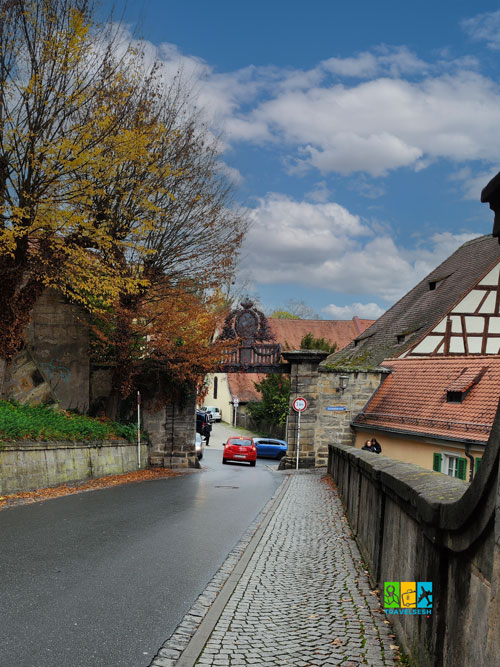
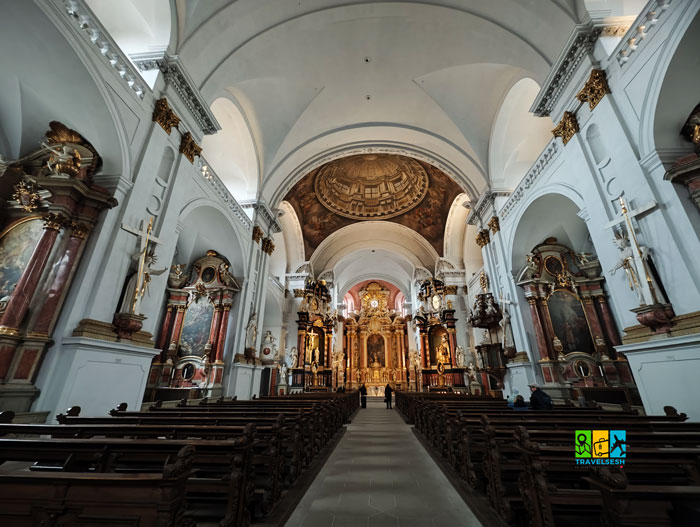
Catholic Church of St. Martin (Kath. Kirche St. Martin)
The only Baroque church in Bamberg, built in the 17th century by the Jesuits. Its façade is decorated with statues of saints, while the interior features illusionistic frescoes typical of the Baroque style. The church stands in the very heart of the Old Town, on Grüner Markt square, and serves as an important architectural landmark. Inside, a peaceful atmosphere contrasts with the lively streets outside.

Catholic Parish Office of St. Martin (Kath. Pfarramt St. Martin)
The parish office of St. Martin’s Church is located right next to the church itself, in the heart of Bamberg. It serves as the spiritual and administrative center of the parish, where church services, baptisms, and wedding ceremonies are held. The building has preserved its historical appearance and harmoniously fits into the architecture of the Old Town.
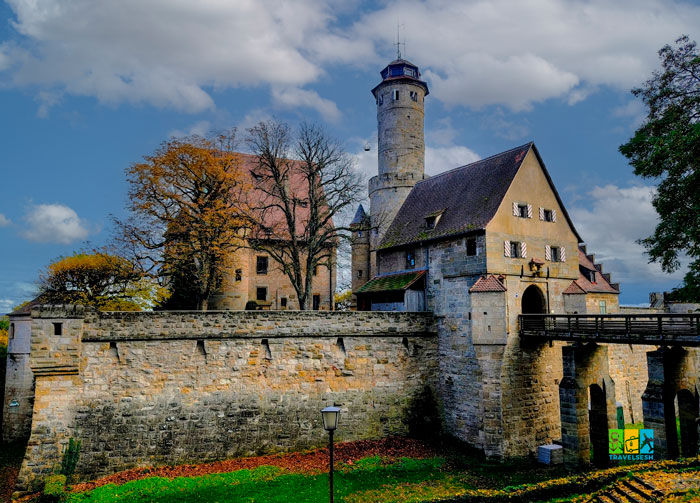
Altenburg Castle (Altenburg Castle)
The main elevated landmark of Bamberg, located on a hill above the city. Its history dates back to the 11th century, when a fortress stood here serving as a residence for the bishops of Bamberg. After being destroyed in the 18th century, the castle was rebuilt and today serves as a favorite viewpoint for both locals and visitors.
The central feature of the complex is the Altenburg Tower (Turm der Altenburg), which offers a panoramic view of the entire city and the Regnitz Valley. Inside, there is a small museum and restaurant. The castle looks especially impressive at night when it seems to float above the city in a glow of lights.
Museums of Bamberg
Historical Museum of Bamberg (Historisches Museum Bamberg)
Located in the magnificent former Episcopal Palace on Domplatz Square, right next to the Cathedral. The museum introduces visitors to the centuries-long history of the city, from the early Middle Ages to the present day.
Its collection includes archaeological finds, antique maps, clocks, instruments, paintings, household items, and costumes that depict the life of Bamberg’s residents across different eras. Special attention is given to the period when Bamberg was an Episcopal residence and a center of religious authority.
Opening hours: Tuesday–Sunday and public holidays: 10:00–17:00. On Christmas Eve (24 December): 11:00–16:00.
Closed on Mondays.
Admission: Adults: €8, Children and youth under 18: free. Students (19+): €4.
Combination tickets (e.g., “Domberg-Ticket”) are available for visiting several museums at once.
Bamberg Diocesan Museum (Bamberg Diocesan Museum)
The main treasure of the collection is the crown of Empress Cunigunde, wife of Emperor Henry II, the founder of Bamberg Cathedral. The museum also houses unique ceremonial vestments from the 11th century, embroidered with gold thread — some of the oldest surviving textiles in Europe.
Opening hours: April to October: daily except Monday, 10:00–17:00.
November to March: closed.
Admission: Adults €5, Reduced €3, Children under 10 free.

Franconian Brewery Museum (Fränkisches Brauereimuseum Bamberg)
A unique museum dedicated to the history and culture of brewing in Franconia — a region with the highest density of breweries in the world. Located in the former St. Michael’s Monastery (Kloster St. Michael), the museum covers more than 1000 years of beer tradition.
The exhibition features ancient copper kettles, brewing tools, labels, glasses, and documents illustrating the development of beer culture from the Middle Ages to the present day. A special highlight is the section devoted to smoked beer (Rauchbier), for which Bamberg is famous worldwide.
The museum operates seasonally (from spring to autumn) and offers tastings of local beer varieties. It’s the perfect place for anyone who wants to understand why Bamberg is the brewing capital of Franconia.
Opening hours: April–October: Wednesday–Friday: 1:00 PM–5:00 PM. Saturday, Sunday, and public holidays: 11:00 AM–5:00 PM.
Admission: Adults: €4.00. Concessions: €3.50. Family ticket (up to 2 adults + children): €7.00. BAMBERGcard holders: free admission.
Bamberg Museum of Natural History (Naturkundemuseum Bamberg)
One of the oldest natural history museums in Bavaria, founded back in the 18th century. Located in the former Jesuit college near the Old Town, it impresses visitors with its classic “old-school museum” atmosphere — wooden showcases, glass collections, and vintage labels.
The museum halls feature minerals, fossils, taxidermied animals, collections of butterflies and birds, as well as fascinating dioramas depicting Franconian flora and fauna. The museum’s pride is the “Hall of Natural Wonders” (Wunderkammer), preserved in its original 18th-century form.
The museum will delight not only children but also adults, offering a glimpse into the spirit of scientific discovery in old Europe.
Opening hours: April 1 – September 30: daily from 9:00 AM to 5:00 PM. October 1 – March 31: daily from 10:00 AM to 4:00 PM. Closed on Mondays.
Admission: Adults: €3.50. Concessions (students, seniors, people with disabilities): €2.00. Children and teenagers (6–18 years): €1.50. University students: €1.00. BAMBERGcard holders: free admission.
E.T.A. Hoffmann House (E.T.A. Hoffmann-Haus)
A museum dedicated to the famous German writer, composer, and artist Ernst Theodor Amadeus Hoffmann, who lived in Bamberg in the early 19th century. It was here that he created some of his most renowned works, including “Little Zaches” and “The Life and Opinions of the Tomcat Murr”. The museum displays Hoffmann’s personal belongings, period interiors, manuscripts, engravings, and musical instruments. The house preserves the spirit of his era — a place that seems to transport visitors into the world of fantasy, mystery, and romanticism so characteristic of his work.
Opening hours: Currently closed for renovation. According to official information, reopening is planned for 2026.

Art Gallery Neue Residenz (Staatsgalerie in der Neuen Residenz)
An elegant collection of 17th–18th century paintings featuring works by German and Flemish masters, including Lucas Cranach the Elder. Combine your visit with a walk in the adjacent rose garden — one of Bamberg’s most beautiful spots in summer.
Opening hours: April 1 – October 3: daily 9:00 AM–6:00 PM. October 4 – March 31: daily 10:00 AM–4:00 PM.
Admission: Adults: €7. Concessions (students, seniors): €5.
Gardener and Häcker Museum (Gärtner- und Häckermuseum)
The museum is housed in a typical 19th-century gardener’s home in Bamberg’s historic district. It is dedicated to the life and work of local gardeners and vintners who played a key role in the city’s development. The exhibition includes original furniture, tools, flags, and church artifacts reflecting the religious traditions of these professions. In the museum garden, licorice is cultivated following old methods — once an important local trade until the 19th century.
Opening hours: (April 21 – November 5): Tuesday – Sunday: 11:00 AM – 5:00 PM. Monday: closed.
Admission: Adults: €5. Seniors (65+): €4. Children: €1.

BambergCard
A convenient tourist pass that allows you to explore Bamberg’s main attractions over three days with significant savings. The card includes free use of public transport, discounts on museums, and one complimentary sightseeing tour.

– Free use of all city buses for 3 days.
– Entry to several Bamberg museums, including the Historical Museum, Diocesan Museum, and Museum of Natural History.
– Guided city tour (walking or bus, depending on the season).
– Discounts at selected restaurants and tourist attractions.
Price: around €22 per person (actual price may vary depending on the season).
Where to buy: at the Bamberg Tourismus & Kongress Service (Geyerswörthstraße 5) or online.
Validity: 3 days from the first use.
Where to Eat
Schlenkerla Brewery (Schlenkerla Brauerei)
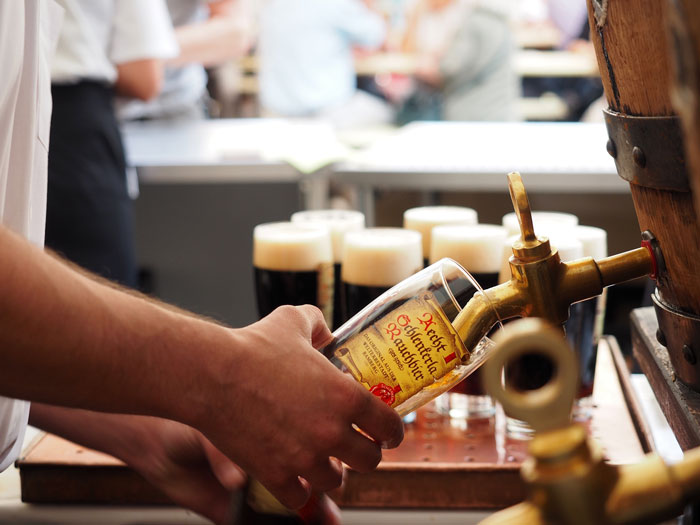
The legendary Bamberg brewery is famous for its signature smoked beer Rauchbier, which has become a true symbol of the city. Founded back in the 15th century, it is located in the heart of the Old Town, not far from the cathedral.
The atmosphere here is authentic: wooden beams, old barrels, the scent of smoke and malt — everything recalls the ancient traditions of Bavarian brewing. In the tavern next to the brewery, you can try Aecht Schlenkerla Rauchbier, served straight from wooden barrels, as well as traditional Franconian dishes — pork ribs, pretzels, and sausages.
Tip: Come closer to the evening — locals often occupy the tables, and the atmosphere becomes especially lively.

Hof Bäckerei Seel
A cozy family bakery with many years of tradition, where aromatic bread and fresh pastries are baked right from the oven. The air is always filled with the scent of vanilla, cinnamon, and coffee — a true paradise for sweet lovers.
Tip: Try their signature raisin bun or traditional Franconian bread — perfect with your morning coffee after a walk through the Old Town.
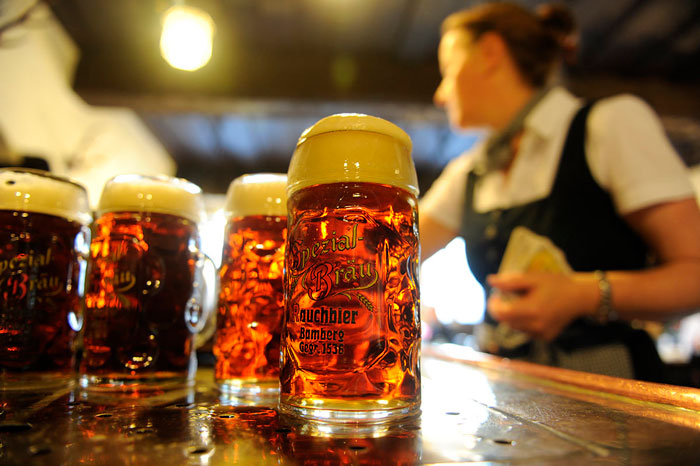
Brauerei Spezial
One of the oldest breweries in Bamberg, founded in 1536. It is famous for its Rauchbier, brewed using traditional technology that involves drying the malt over oak wood.
The atmosphere is typically Bavarian: wooden tables, foamy mugs, local chatter, and the aroma of freshly brewed beer.
Tip: Be sure to try Spezial Rauchbier Lager — milder than Schlenkerla’s version but with a deep smoky flavor. It pairs perfectly with Franconian sausages or smoked cheese.
Zum Sternla
The oldest restaurant in Bamberg, with a history dating back to 1380. Here, you can taste dishes of old Franconia in the authentic atmosphere of the historic town. Wooden beams, wrought-iron chandeliers, the aroma of roasted meat, and Bavarian songs create a unique local charm.
Tip: Be sure to order Schäuferla — roasted pork shoulder with potato dumplings. It’s a classic of Franconian cuisine, prepared here according to an old traditional recipe.
Bamberg Tours
City Tour Bus — Der BambergBus
Der BambergBus is a convenient way to see Bamberg’s main sights without rushing. The bus follows a route lasting about an hour and operates in Hop-On Hop-Off mode, allowing passengers to get off and rejoin the tour at any stop.
The route passes through the historic city center and includes landmarks such as the Old Town Hall, Bamberg Cathedral, Michaelsberg Monastery, and other UNESCO World Heritage sites. The bus also travels through picturesque, non-touristy streets, revealing charming views of the city.

Main season: April 1 – November 2 (daily, from 10:00 to 17:14).
Winter season: March 1–31 and November 2 – January 5 (Fri–Mon, from 10:00 to 15:14).
Closed: January 7 – February 28; holidays December 24–26 and January 1 — no service.
Departures are every hour.
Ticket prices:
Adults — €14.50. Children (3–14 years) — €7.50.
Family ticket (2 adults + children/grandchildren up to 14 years) — €36.50.
Tickets can be purchased directly on the bus or at the city’s tourist information center.
The tour is suitable for both adults and children. Audio commentary is available in several languages — German, English, and others.
More details and the full schedule are available on the official website.
Boat Trip through Little Venice
One of the most popular activities during the warm season. The sightseeing boats cruise along the picturesque row of fishermen’s houses, bridges, and terraces of the Old Town. From the water, you can enjoy magnificent views of the Old Town Hall and the historic riverfront.
The tour lasts about 45 minutes and starts from the Kranen bridge. Tickets can be purchased on-site before departure.
Tip: The best time for a boat ride is around sunset when the facades of the old houses reflect in the water, creating stunning photo opportunities.
Night Torchlight Tour
An atmospheric guided walk through Bamberg’s medieval streets filled with legends and mysterious stories. Perfect for experiencing the old town’s charm without the tourist crowds.
Bamberg Beer Tour
The city is famous for its beer culture — there are over 10 breweries here! During the tour, you can sample several types of beer, including the legendary Rauchbier. The tour covers historic breweries such as Schlenkerla and Klosterbräu, the oldest brewery in the city (founded in 1533).
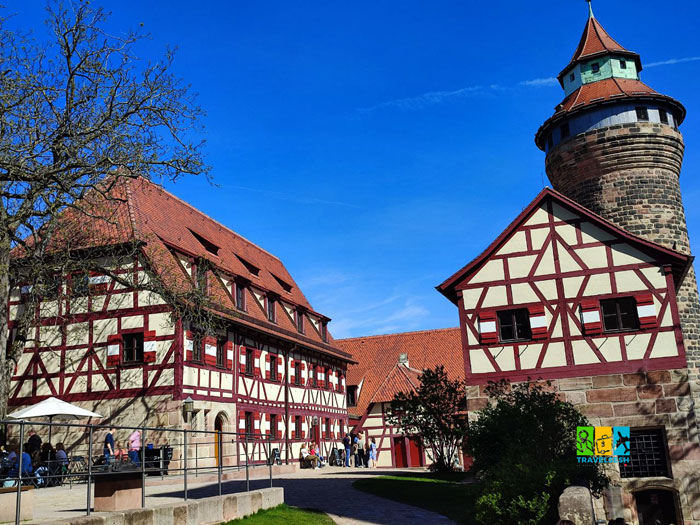
Located on one of Bamberg’s seven hills, this historic Benedictine complex offers beautiful panoramic views of the city. Inside, there is a small museum and a cozy café where you can rest after the climb.
Day Trips from Bamberg
Bamberg is an excellent base for short trips around northern Bavaria. Thanks to its convenient rail connections, it’s easy to reach several charming towns, each with its own unique atmosphere and architectural highlights. From here, you can easily visit nearby cities:
Coburg — (about 1 hour by train)
A picturesque town known for Veste Coburg Castle — one of the best-preserved fortress complexes in Germany. Martin Luther once lived here during the Reformation. From the hilltop, you’ll get panoramic views of the entire city. The old town of Coburg is cozy, with historic buildings and lovely cafés.

Bayreuth — (approximately 1.5 hours by train)
A city famous thanks to the composer Richard Wagner. Every year, it hosts the world-renowned Wagner Festival at the magnificent Margravial Opera House (a UNESCO World Heritage site). In addition, Bayreuth attracts visitors with its well-kept parks, the Hermitage Palace, and charming streets;
Nuremberg — (approximately 1 hour by train)
The historic center of Franconia, worth spending at least a day. The old town features the Kaiserburg Castle, Hauptmarkt Square with the Schöner Brunnen fountain, medieval gates, museums, and of course, the famous Nuremberg sausage and gingerbread. If you visit in December, be sure to check out the Christkindlesmarkt Christmas Market, one of the most famous in Europe.
How to Get There
Bamberg is located in the northern part of Bavaria, about 60 km from Nuremberg. The city has excellent transport connections — it is easy to reach by train, car, or public transport.
By Train.
Regional trains RE and RB run hourly from Nuremberg to Bamberg. The journey takes about 1 hour, making it the most convenient option for a short trip.
From Munich, it takes approximately 2.5 hours, usually with a transfer in Nuremberg. Tickets are best purchased in advance on the Deutsche Bahn website.
From Berlin, you can reach Bamberg Hbf directly by ICE high-speed train in 3.5–4 hours.
By Car.
Bamberg is conveniently located near the A70 autobahn, connecting the city with major Bavarian highways. There are traffic restrictions in the historic center, so it is better to leave your car in underground parking Geyerswörthgarage or Parkhaus Zentrum Süd, costing from €2 per hour or €18 per day, with a night rate (20:00–07:00) of €5.
A free alternative is P+R Kronacher Straße, from where the city center is easily accessible by bus.
By Public Transport.
The city has an efficient bus system, Stadtbus Bamberg, connecting the station and the central area. The main transfer hub is ZOB (Zentraler Omnibusbahnhof) near the Old Town.
Tip: if you plan a day trip from Nuremberg or Würzburg, use the Bayern-Ticket — it is valid on all regional trains and public transport within Bavaria and is cost-effective for two or more people.
Travel Tips
How much time is needed: one day is enough to see the main sights. But if you want to fully enjoy the atmosphere, it is worth staying for 2 days.
When to visit: the best time is spring or early autumn. In summer, the city comes alive with festivals, and in winter it transforms into a fairy-tale location with a Christmas market.
Parking: there are few spots in the center, so it is more convenient to use underground parking at Geyerswörthgarage or Parkhaus Zentrum Süd, or leave your car at P+R Kronacher Straße and continue by public transport.
Getting around: the historic center is small — the best way to explore it is on foot.
Good to know: Bamberg is built on seven hills, so wear comfortable shoes — walks include some uphill routes.
Beer: try the local Rauchbier — a smoked beer with a unique taste that either captivates at the first sip or leaves a lasting “acquired taste” impression.
Conclusion
Bamberg is a true gem of Bavaria, where old streets, stone bridges, and the aromas of smoked beer create a unique atmosphere. Life here is unhurried — just enjoy the moment, the views, and the friendly vibe of a small town with great character.
If you want to feel the spirit of old Germany without the tourist hustle, Bamberg will definitely charm you.
The city of Bamberg is one of the most beautiful corners of Bavaria, famous for its medieval architecture, numerous breweries, and historic districts. Its historic center is listed as a UNESCO World Heritage Site.
How to get there: From Nuremberg — about 1 hour by train (RE or RB). From Munich — approximately 2.5 hours, with a transfer in Nuremberg. From Berlin — 3.5–4 hours by ICE high-speed train. For travelers by car, access via the A70 autobahn is convenient. It is best to leave your car in underground parking Geyerswörthgarage or Parkhaus Zentrum Süd, or use the free parking P+R Kronacher Straße with easy bus connections to the center.
Public transport: The city has a convenient bus network. A cost-effective option for tourists is the BambergCard — a 3-day card including travel on all city lines, free entry to museums, and a city tour. It can be purchased at Bamberg Tourismus & Kongress Service on Geyerswörthstraße 5 or online at the official website.
Where to stay: In Bamberg, you can find both historic hotels and modern apartments. Popular options: Hotel Nepomuk — in the heart of the Old Town, over the water. Ibis Styles Bamberg — modern comfort in the center.
There are no comments for this post. Comment or ask questions first