
A scenic route that runs through the Uzhock Pass (49°0’17″N 22°53’20″E) covers the landscape zone from the village of Turky to Uzhhorod and crosses the Upper Dniester Beskydy with beech and fir-beech forests, the Polonyn ridge with mainly beech forests and the Vyhorlat-Hutinsky ridge with beech and oak-beech forests.
Along the route there are many nature reserves, monuments of nature and architecture, and the pass itself is part of the Uzhan National Nature Park, which is part of the world’s only tripartite International Biosphere Reserve “Eastern Carpathians”.
Uzhock Pass has a rich history . In the Middle Ages, the trade route from Kievan Rus to the countries of the Danube basin passed here.

Most of the territory around the pass belongs to the lands of the Lemkos, a small ethnic group of Ukrainians who live in the mountains and are distinguished by their original way of life and wooden architecture. In populated areas Uzhok, Sil, Kostrina, Сухий, Гусний unique monuments of wooden architecture have been preserved – churches of the 17th and 18th centuries.
Uzhok
(48°59’8″N 22°51’7″E)
Written sources mention the village from 1582. and testify that Uzhok belonged to the Druget family by hereditary right.
The wooden church of St. Mykhailo, 1745 with the classic Verkhovyna belfry of 1927.

Alpine skiing tracks:
Ski resort Uzhok (Volosyanka) with a cable car lift next to the recreation center “Uzhok”.
Kostrina
(48°56’35″N 22°35’12″E)
Kostryna belonged to the Uzhgorod-Nevitskyi Dominion of the Drugets. Sources of the 18th century. it is reported that there was a customs house in Kostryna (probably from the 16th century)
There is evidence that the first wooden church in the village was built in 1451, the second church was built in 1602, and the third Church of the Intercession of the Holy Virgin was moved from the village of Syanka, Turkiv district, Lviv region, and erected in the Sygot tract in 1645. In 1703, due to the threat of flooding, the church was moved to its current location.

Sil
(48°56’59″N 22°31’35″E)
The first mention of the taxation of the village dates back to 1567. At that time, the village belonged to the Uzhhorod-Nevytskyi dominion of the Drugets counts.
In 1866, the largest meteorite in Europe fell on the outskirts of the village of Sil and Knyagina, the remains of which are in the exposition of the regional local history museum, as well as in the museums of Vienna and Moscow.
Information about the first wooden church of the Assumption of the Blessed Virgin Mary is mentioned in sources in 1479. But the church burned down in 1707 to Soli from the village. The Syankas moved a three-story wooden church in the Boykov style (1703). There is also a version that the church was moved to Sil at the end of the 18th century.

Perechyn
(48°44’8″N 22°28’15″E)
Archaeological finds of the Stone and Middle Stone Ages, burial sites of the Copper and Early Iron Ages were discovered in the vicinity of Perechyn.
In 1902, the Perchyn Roman Catholic community was formed. Believers did not have their own church, so they had to visit the Greek-Catholic Church of St. Mykolaya, built in the city of Hurka.
In Perechina, it is worth visiting the bronze monument to the postman Fedor Fekete (sk. M. Belen), which is also depicted on the bas-relief of the church in the village Turi Remety, where he lived. The monument is located in the park on the central square of the city, and it was made with the funds of the Zakarpattia Directorate of “Ukrposhta”.


Nevytsʹke
(48°40’27″N 22°23’11″E)
In 1290, King András III (r. 1290-1301) appointed the Hungarian feudal lord Omodei (brother of Finti Obo), whose residence was the Nevytskyi fortress (48°40′N 22°24′E), as county governor of the Uzhan Committee. Omodei Obo strengthened the defensive capabilities of the fortification. In 1317, the Nevytskyi fortress was mentioned as a stronghold of the local feudal opposition against the royal power of Karoi (Karl) and Robert of Anjou (r. 1301 – 1342). Since 1328, after the final victory of Charles I Robert, the lord of Nevytskyi became the loyal king Janos Druget.

Uzhhorod
(48°36’52″N 22°16’18″E)
According to Ukrainian scientists, the city was the residence of the Slavic prince Laborets, and Hungarian historians report that the city was the residence of Almos Akkor, one of the cavalry commanders of Prince Arpad. In the 10th century nomadic Hungarian associations attacked the settlement and captured it. The city received the Hungarian name Ungvar, and the fortress became an important stronghold. History of Uzhgorod

Uzhgorod Castle (Kapitulna St., No. 33) is the main attraction of the city of Uzhgorod, the main structure of which dates back to the 14th century.

Work schedule and prices for visits, I wrote in a post about the castle. Be sure to see Uzhgorod Castle
Since 1948, the Transcarpathian Regional History Museum has been operating in Uzhgorod Castle museum.

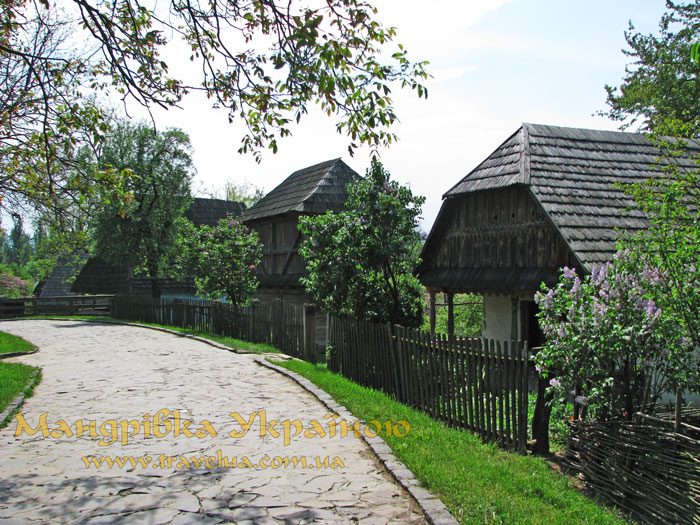
On the southern slope of Zamkova Gora, under the walls of the majestic Uzhgorod Castle on an area of 5.5 hectares is located one of the first in Ukraine Transcarpathian Museum of Folk Architecture and Life, built in 1970 in a place called the “Witch’s Pit” and where those accused of witchcraft used to be burned.
The oldest street of Uzhhorod was once called Zamkova. It was the only street placed within the outer defensive structures of the castle. At the beginning of the 19th century the name Kapitulna, and in Soviet times it was renamed to Kremlin.

Evgeny Fentsyk Square, Pedestrian Bridge and Independence Embankment

Korzo, str. Voloshyna, str. Olbracht
This is the historical center of the city – the central and most crowded Corso street (translated from Italian, “corso” means “street where people stroll”), where there is no greenery at all.

Crossing the pedestrian bridge, we pass to the left bank of the city – this is the so-called New City, the first written mention of which dates back to 1631. New City developed slowly, as it constantly suffered from floods. Only in the 18th century. regulation of the banks of the Uzha began. Worth a look Orthodox Embankment, Sandor Petefi Square and Sq. Cyril and Methodius

St. Dovzhenko, str. Ferenc Rakoci II, People’s Square
It is worth taking a walk along the street. Dovzhenko, where the houses of the Czechoslovak period have been preserved, which are examples of a high level of architectural skill.
The highlight is the barn and wine cellar (1781) (Dovzhenko St./Ferentz Rakotsi II St., No. 2).
Ferenc Rakoci II Street leads us to the famous Loudon Arboretum. Next, we head to People’s Square, where the former building of the People’s Council (Land Administration) is located (arch. A. Krupka). Today it is the building of the regional state administration.
One of the oldest squares of the city – pl. Koryatovych, where fairs were held annually. Her first name is Halkova. Now the square is filled with numerous shops, has a market, a bus station and a train station.

On Zhupanatska Square it is worth visiting the park, where the famous Transcarpathian artists Erdely and Bokshay (1993) sit among the alpine flora. Nearby is a two-story building in the Empire style – the former building of the Uzhan District (1809), which today houses the Transcarpathian Regional Art Museum named after J. Bokshaya (Zhupanatska Square No. 3).

Goryani
(48°36’22.5″N 22°20’13.2″E)
Horyany is a suburb of Uzhhorod, where one of the oldest architectural monuments of Ukraine of pan-European significance is located – the rotunda, which was most likely a castle chapel.

Where to stay
When you zoom out of the map, you can see more offers. Place the cursor on the rectangle with the price for
to see information about the accommodation, or click to proceed to the reservation.
Booking.com
There are no comments for this post. Comment or ask questions first