
The last palace of the sultans of the Ottoman Empire, built from 1842 to 1855 for Sultan Abdul Majid I, who wanted to move away from the building of medieval palace complexes and decided to build a palace in the Baroque style, which will be no worse than 18th century European residences. Six sultans lived in the palace, and after the collapse of the Ottoman Empire, the first president of the Republic of Turkey, Mustafa Kemal Ataturk (1927-1938), settled in Dolmabahçe Palace and died there. Until 1949, the palace was still used as a residence under President Ismet Inenu, and in 1984 a museum was opened.

History and tour of the palace.
In the 17th century, the site of the future Dolmabahçe Palace was a bay where the navy was based and traditional naval ceremonies were held, but over time the bay became a swamp. Therefore, he was buried and organized a garden for recreation and entertainment of the sultans. Hence the name Dolmabahce, translated as “bulk garden”. And the mansions and pavilions built in this garden in different periods were known as the “Palace of Besiktas”. There is no exact date when the old wooden palace was demolished, but all work on land expansion and construction of a new one is calculated in 1842, from this year and consider the demolition of the old and the beginning of construction of a new palace. The new Dolmabahçe Palace decided to build Sultan Abdul Majid with a European plan and style instead of the classic palaces that were still preferred for accommodation, reception, public affairs and summer resort.


Design, decor and equipment.
Dolmabahçe Palace has three floors, 43 halls and 285 rooms, and in the large 56-column reception hall attracts attention a massive 4.5-ton British Crystal chandelier lit by 750 lights. The interior decoration of the palace, silk carpets, furniture and curtains, as well as other items have survived to this day in the original. The walls and ceilings are decorated with images of European artists of that era and tons of gold ornaments. All floors are covered with different, ornamented with wooden parquet. Many rooms of the palace have crystal chandeliers, candlesticks and fireplaces. The interior and exterior decoration of the Dolmabahçe Palace was done using motifs taken from different periods of Western art, such as Baroque, Rococo and Empirical.


In the construction of the palace was used blue marble, mined on the islands of the Marmara Sea, and the interior was made of precious marble, crystal and porphyry. Wall and ceiling decorations of the palace were made by Italian and French artists. All fabrics for upholstery and draping are local and were made in the palace’s weaving mills. The floor of the palace, which covers an area of approximately 4,500 square meters, boasts 141 carpets and 115 prayer carpets. Most carpets are made on looms at the Hereke factory in Turkey. The total number of chandeliers in Bohemia, Baccarat and Besiktas is 36.
Material of candlesticks on the pedestal of some fireplaces, crystal railings for stairs and all crystal mirrors. The palace also has 581 crystal and silver candlesticks. In the palace of 280 vases, from China, Japan and various European countries, 158 hours, about 600 paintings by Turkish and foreign artists.
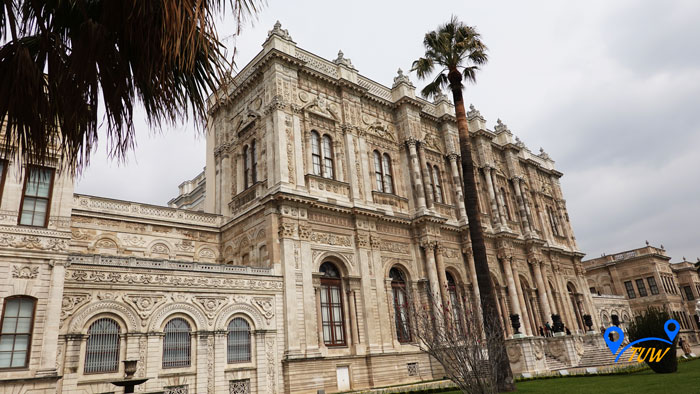

Among them are 19 paintings by the chief painter of the palace of Zonar and Aivazovsky, who came to Istanbul during the reign of Abdulaziz. From the very beginning of the construction of the palace, the highest standards were implemented. Gas lighting, water tanks were brought from Britain, while palaces in continental Europe did not yet have these features. Later, electricity was installed, an elevator and a central heating system were installed.


Rooms.
Main entrance, Medhal Hall.
The visit to Dolmabahçe Palace starts from the main hall of Medhal. The rooms leading from the Medhal Hall overlook the sea and the garden. The rooms overlooking the sea were used by officials, viziers and ministers, and those overlooking the garden were used by various administrative bodies of the palace and the state. Medhal Hall witnessed the historical events of the period of the establishment of the Republic. Important revolutionary meetings, such as the Historical Congress, took place in this hall.


The second room on the right – the Clerk’s Hall, which is also called the Tile Room, and on the left wall of the hall hangs the largest painting in the palace collection – the image of Surrey of the procession, Stefano Ussi. On the wall on the right, a painting depicts a fire in the Paris Municipal Theater signed by Rudolf Ernst.

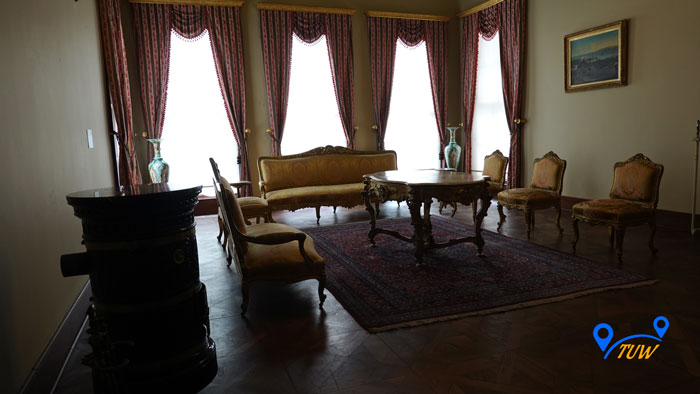

Crystal stairs.
The staircase up from Medhal Hall, which is the protocol entrance to the palace, is one of the most important parts of the palace. Another name for the Crystal Stairs is the Sultanate Stairs. The name comes from the fact that the balusters are made of crystal, which is raised by twisting in the Baroque style. And in the middle of the stairs hangs a beautiful crystal chandelier that transmits daylight through the glass cover of the vault on the ceiling.
Where to stay near Dolmabahçe Palace
Swissotel The Bosphorus Istanbul Rating 9,0
The luxurious 5-star Swissotel The Bosphorus Istanbul received the Safehotels International Security Certificate in 2016 and 2017. It features an exclusive rooftop pool and a wonderful spa. The windows of the apartment offer an unsurpassed view of the Bosphorus.
Union Hotel Rating 9,0
The Union Hotel serves an à la carte breakfast or a halal breakfast. Popular hotels include Istiklal Street, Dolmabahçe Clock Tower and Dolmabahçe Palace.
Shangri-La Bosphorus, Istanbul Rating 9,2
Shangri-La Bosphorus Hotel, Istanbul is located on the European shores of the Bosphorus, between Dolmabahçe Palace and the Naval Museum. This luxury hotel features an indoor pool, spa and rooms with elegant design and modern amenities.
X FLATS TAKSİM Rating 9,2
X FLATS TAKSİM Apartments are located in the center of Istanbul, less than 1 km from Taksim Square and a 19-minute walk from Dolmabahçe Palace. It offers free Wi-Fi and air conditioning. From the room you can go to the garden with terrace.
Sufera Hall.
One of the important halls of the palace for receptions of ambassadors of foreign countries and official guests, it hosted such ambassadors as the ambassadors of France, Austria and Italy. One of the important items in the hall is the Erard piano. The piano is signed by Sultan Abdul Majid.


Ataturk’s room.
President Ataturk spent the last days of his life at the Dolmabahçe Palace. He died in the bedroom of the former harem part of the palace on November 10, 1938. After his death, all the palace clocks were stopped at the time of his death, 9:05. At this time, all clocks are set to the actual time in Turkey , except for the clock in the room where he died.


Goal.
Sultan’s Gate, Treasury Gate, Bosphorus Gate.

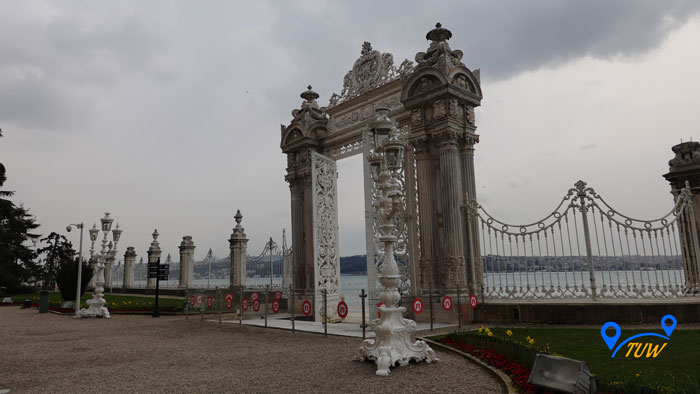


Neighboring buildings.
Nearby are a number of buildings associated with the Dolmabahçe Palace , such as rooms for visiting gentlemen, dormitories for servants and guards, rooms of the chief eunuch, as well as other buildings include the Sultan’s kitchens, stables, enclosures, nursery plants, flour mill, greenhouse, Hereke carpet workshop, pharmacy, glass manufactory, foundry.


Cost to visit.
The main palace (Selamlik) – 90 lira
Harem – 60 lira
Complex ticket main palace + harem – 120 lira
Museums – 30 lira
Entrance to the gardens – 10 rounds. lyre (you can enter the parks without visiting the palace and other premises)
Free admission, annually, on November 10, Ataturk’s Remembrance Day.
The museum card in the Dolmabahçe Palace is not valid.


Hours of work
Open for visits daily from 09:00 to 17:00, except Mondays and national holidays.
Despite the restrictions on Coronavirus for tourists, it works normally. The temperature is measured at the entrance, the presence of a mask is required. Entrance to the palace only in boot covers, which can be taken at the entrance to the palace for free. To get to the territory you need to go through the scanner at the airport, and then you can buy tickets to visit. In all rooms, museums, photo and video shooting is prohibited, but it is purely on your conscience, especially it is not controlled.
How to get
The easiest way is to take the T1 high-speed tram to the final stop Kabatas, where you will see the entrance to the Dolmabahçe Mosque in just 5 minutes along the promenade.
From Taksim Square go down the funicular or on foot (along the way you can see many interesting objects) to the stop Kabatas
From the Asian side, sail by ferry to the Kabatas berth


Where to stay
To see more housing offers, we recommend adjusting the scale of the map to your device. Hover over the price rectangle to get information about the apartment, and click to go to the reservation.
Booking.com
There are no comments for this post. Comment or ask questions first